The EU Deforestation Regulation (EUDR) will apply from the end of 2026. The Regulation broadly applies to companies in various sectors and in different parts of supply chains. On this page, you will find a summary of the key points of the EUDR. You can explore the topic in more detail in other sections of this website, as well as in the Regulation itself.
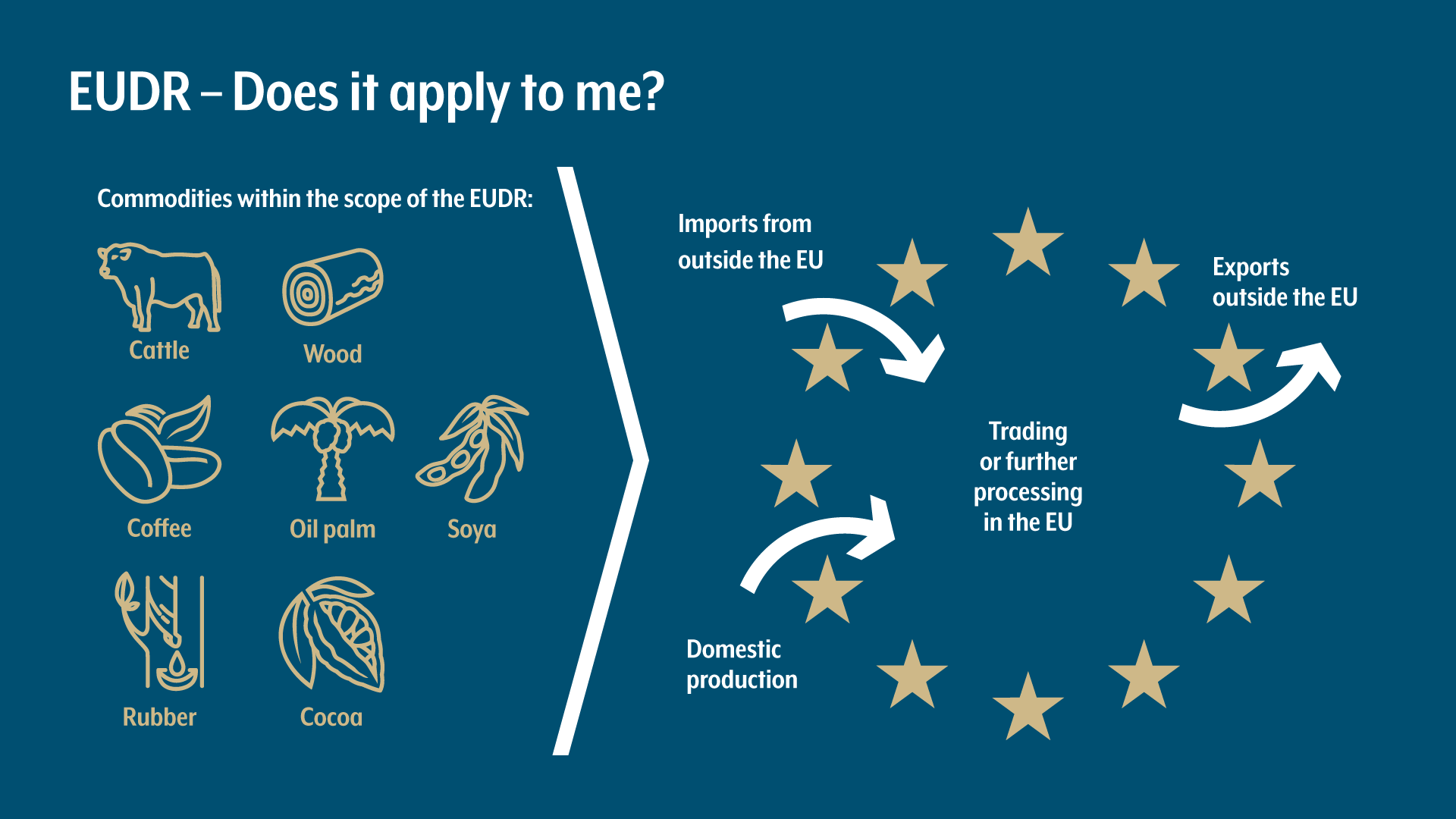
Does the EUDR apply to you?
The Regulation covers wood, cattle, coffee, cocoa, soya, oil palm and rubber, as well as certain products derived from these commodities that are listed in Annex I to the EUDR.
The EUDR applies to imports into the EU, exports from the EU, trade within a Member State and within the EU, domestic production, and further processing within a Member State and within the EU.
The Regulation sets specific requirements for companies operating in the aforementioned roles. The required measures depend on the size of the company and its role in the supply chain, for example.
The Regulation will apply from 30 December 2026. For micro and small enterprises, the transitional period will continue until 29 June 2027. Please note: the extended transitional period does not apply to products covered by the current EU Timber Regulation (EUTR).
Identify your role under the EUDR
The measures required by the EUDR vary depending on whether your company is considered to be an operator, a micro or small primary operator, a downstream operator or a trader under the Regulation.
Below are the roles defined in the EUDR with examples:
OPERATOR
In the EUDR, an operator means a natural or legal person who, in the course of a commercial activity, places relevant products on the market or exports them, except for downstream operators.
An importer from outside the EU is considered an operator, as is the first operator that places wood or cattle on the domestic market (other than a ''micro or small primary operator'').
MICRO OR SMALL PRIMARY OPERATOR
Under the EUDR, a micro or small primary operator means an operator who:
- is a natural person or a micro or small enterprise*;
- is established in a country classified as low risk in accordance with the Regulation;
- and who, in the course of a commercial activity, places on the market or exports products that the operator itself has grown, harvested or obtained from relevant plots of land, or, in the case of cattle, raised on establishments located in that country.
For example, a cattle farm that falls within the size category of a micro or small enterprise and breeds calves, or a forest owner conducting stumpage sales, may be considered a micro or small primary operator.
What are the thresholds for a small undertaking?
One of the following thresholds may be exceeded:
- Balance sheet total: EUR 7,500,000
- Net turnover: EUR 15,000,000
- Average number of employees during the financial year: 50
*) Operators who exceed the limits of at least two of the three criteria set out in Article 3(1) and (2), first subparagraph, of Directive 2013/34/EU but who can demonstrate that the parts of their balance sheet total, net turnover and average number of employees during the financial year, related to the relevant commodities and the relevant products, do not exceed the limits of at least two of three of those criteria.Only business activities falling within the scope of the EUDR are taken into account when calculating these thresholds. For more information, see FAQ 3.25.
DOWNSTREAM OPERATOR
Under the EUDR, a downstream operator means a natural or legal person who, in the course of a commercial activity, places on the market or exports relevant products made using relevant products, all of which are covered by a due diligence statement or a simplified declaration.
Downstream operators include further processors and companies exporting products that have already been placed on the market by an operator.
TRADER
Under the EUDR, trading means business activities within the EU concerning products that have already been placed on the market by an operator.
Example 1: Importers (from outside the EU) of wooden furniture are operators, regardless of the size of the import company.
Example 2: If you purchase wooden furniture from an importer and sell it in your shop, you are considered a trader.
Example 3: If you purchase a product/raw material covered by the Regulation (e.g. cocoa) from the EU internal market and use it to manufacture another product covered by the Regulation (e.g. chocolate), you are considered a downstream operator.
Example 4: If you purchase a product/raw material covered by the Regulation (e.g. cocoa) from the EU internal market and use it to manufacture a product that is not listed in Annex I to the Regulation (e.g. biscuits), you are not subject to obligations, as you are not trading within the meaning of the Regulation and therefore have no obligations under it.
What measures does the EUDR require?
Under the EUDR, the commodities or products listed in Annex I may only be placed on the market if:
- they have not caused deforestation;
- they have been produced in accordance with the legislation of the country of production; and
- a due diligence statement (DDS) or a simplified declaration has been submitted for them.
The EUDR requires slightly different measures from companies depending on their role. Below, you will find a summary of the measures required for each role. In addition to the role defined in the EUDR, the size of the company determines what measures are required. Read the detailed obligations in Chapter 2 of the EUDR.
Operator’s obligations
1. Ensure that your due diligence system is in place
Through the due diligence (DD) system, you carry out the required collection of information, risk assessment and potential risk mitigation. Operators must have a DD system in place.
2. Submit a DDS in the EUDR Information System
Submit an electronic due diligence statement (DDS) in the EUDR Information System before placing products on the market or exporting them.
3. Forward the DDS reference number
Provide the buyer of the products with the reference number of the DDS related to the products if the buyer remains subject to obligations under the EUDR. The buyer has an obligation to request the DDS reference number.
4. Report non-compliance
Notify the competent authority and the companies to which you have supplied products of any cases that come to your attention that include indications of possible non-compliance.
5. Reporting obligation of large undertakings
Large undertakings that are operators as defined in the Regulation, are required to issue public reports on their DD system annually (see Large undertakings and the EUDR).
Micro or small primary operator’s obligations
1. Submit a one-time simplified declaration in the EUDR Information System
Submit an electronic one-time simplified declaration in the EUDR Information System before placing products on the market or exporting them. The information may be updated if significant changes occur after submitting the declaration.
The Finnish Food Authority will upload the required data for the domestic cattle sector to the EUDR Information System. Further details will be provided at a later date.
2. Forward the declaration identifier
Provide the reference number of the simplified due diligence statement to the buyer of the products, except where the buyer is a consumer.
Downstream operator’s and trader’s obligations
1. Verify whether the EUDR applies to you
Check whether your product is listed in Annex I to the Regulation. You are a downstream operator or a trader if you continue to sell products covered by the EUDR. You are not subject to the obligations of the Regulation if you use products covered by it yourself (e.g. purchasing coffee for consumption in your office).
2. Obligation of large undertakings to register in the EUDR Information System
Downstream operators and traders that are large undertakings must register in the EUDR Information System.
3. Collect and retain information about suppliers and customers
Keep records of the company name, registered trade name or trademark, address details, email address and website of the suppliers of the relevant products and of the companies to which the products have been supplied.
4. Keep the reference number or due diligence statement reference number received from the operator.
If your supplier is an operator as defined in the Regulation, they will provide you with the reference number of the due diligence statement or the identifier of the simplified due diligence statement for the products.
5. Report non-compliance
Notify the competent authority and the companies to which you have supplied products of any cases that come to your attention that include indications of possible non-compliance.
Large undertakings have additional obligations. For more information, see Article 5(6) of the amending Regulation and the "Large undertakings & EUDR" page.
Why should my company ensure compliance with the EUDR before the end of 2026?
The EUDR will apply from the end of 2026. From that date onwards, compliance with the requirements of the Regulation must be ensured for commodities and products falling within its scope when placing them on the market, exporting them or trading them.
If you have taken the measures required by the EUDR for imports and have submitted the DD statement, customs clearance will proceed smoothly, and consignments will not be held at the border or even returned to their point of departure.
The collection of information, risk assessment and risk mitigation required by the EUDR for commodities and products improve companies’ responsibility, understanding and transparency in their supply chain. This reduces the risk of unexpected reputational damage related to commodities and products.
In the future, consumers can purchase products covered by the EUDR with greater confidence, as the legislation requires that no global deforestation has been caused in their production chain, and that the legislation of the country of origin has been complied with.