Page updated 04/2026 to reflect the amendment regulation.
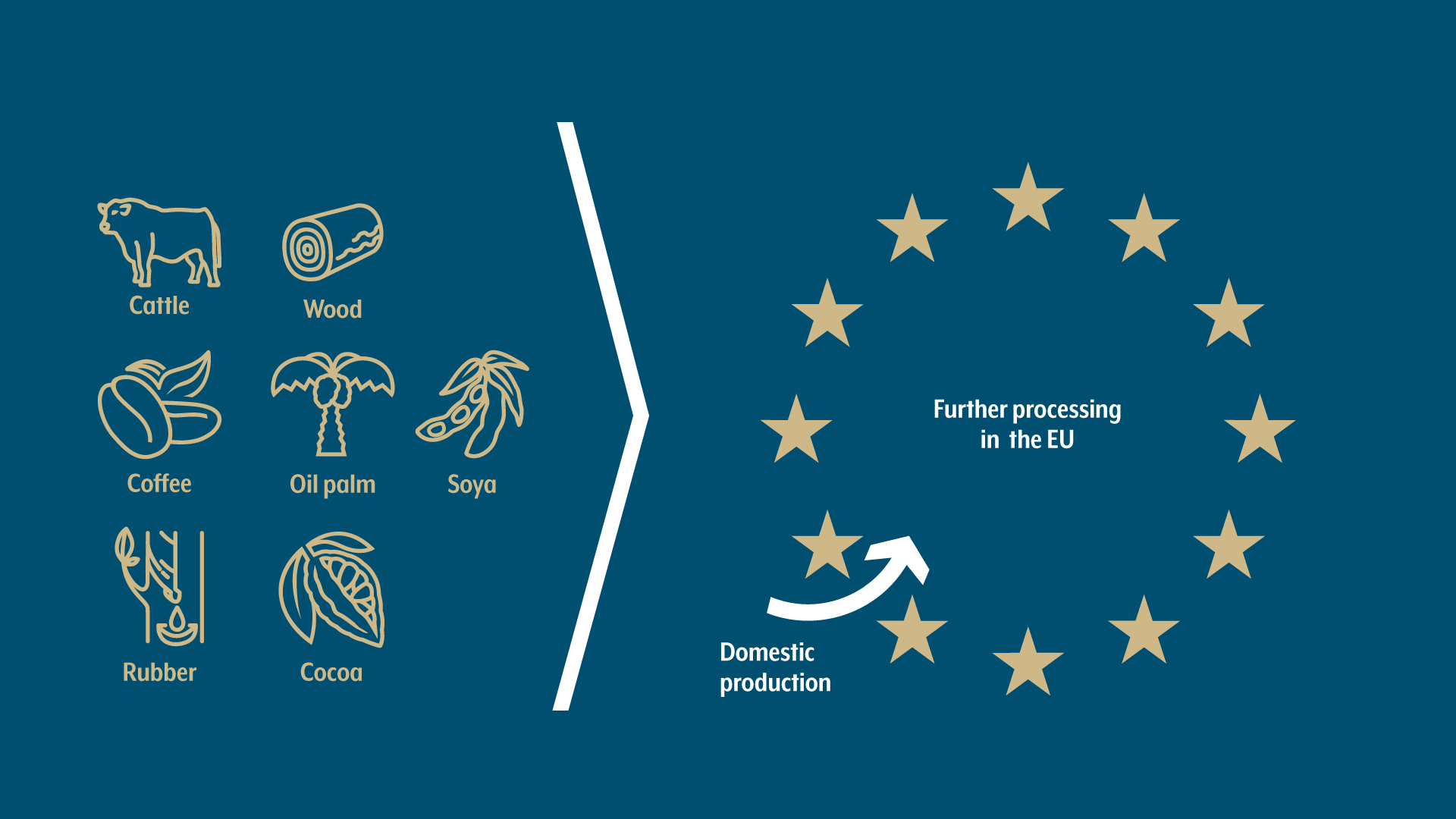
The EUDR also applies to the domestic production and further processing of commodities and products listed in Annex I to the Regulation. Under the EUDR, your role may be that of an operator, a downstream operator, or a micro or small primary operator. The obligations imposed by the Regulation depend on the size of the company and its role in the supply chain, for example.
Operators
In the EUDR, an operator means a natural or legal person who, in the course of a commercial activity, places relevant products on the market or exports them, except for downstream operators.
According to the definition of the Ministry of Agriculture and Forestry, the following are considered operators in Finland (situation as of March 2024):
Cattle industry
- As a rule, cattle slaughterhouses are considered operators.
- If a farmer engages in direct sales, the farmer is considered an operator.
Forest sector
- As a rule, buyers of timber (standing sales) are considered operators.
- In sales at delivered price or delivery sales, the operator is the forest owner or the seller of the timber.
The amending Regulation (EU) 2025/2650 specifically addresses traceability and reporting requirements for primary producers in the cattle sector. The Ministry of Agriculture and Forestry is reviewing the national policy guidelines in light of the new Regulation.
Measures required from operators
- Check whether your product is listed in Annex I to the EUDR to determine whether it falls within the scope of the Regulation’s obligations.
- All operators must have a due diligence system, i.e. a DD system, in place to ensure that products placed on the market comply with the EUDR.
- Collect the required information about the products by applying your DD system.
- Carry out a risk assessment and risk mitigation measures for the products by applying your DD system.
- Submit a due diligence statement (DDS) in the EUDR Information System before placing products on the market.
- Provide the buyer of the products with the reference number of the DDS related to the batch if the buyer remains subject to obligations under the EUDR. The buyer has an obligation to request the DDS reference number.
- Retain information about DDS statements for at least five years.
- Notify the competent authority and the companies to which you have supplied products of any cases that come to your attention that include indications of possible non-compliance. See Article 4(5) of the EUDR.
- Large undertakings are obligated to issue public reports on their DD system on an annual basis.
Measures required from micro or small primary operators
- Check whether your product is listed in Annex I to the EUDR to determine whether it falls within the scope of the Regulation’s obligations.
- Ensure that products placed on the market comply with the requirements of the Regulation.
- Submit an electronic one-time simplified declaration in the EUDR Information System before placing products on the market or exporting them. The information may be updated if significant changes occur after submitting the declaration. The declaration does not need to be submitted if the required information is already available in a system established under other legislation. The Finnish Food Authority is examining the possibility of submitting the simplified declaration on behalf of micro or small primary operators (status in February 2026).
- Provide the buyer of the products with the identifier of the simplified declaration if the buyer remains subject to obligations under the EUDR. The buyer has an obligation to request the declaration identifier.
Measures required from downstream operators
- Check whether your product is listed in Annex I to the EUDR to determine whether it falls within the scope of the Regulation’s obligations.
- You are a downstream operator if you purchase a raw material from the EU internal market for which due diligence has already been carried out and further process it into new products listed in Annex I to the Regulation.
- Large undertakings must register in the EUDR Information System before placing products on the market, making them available on the market or exporting them.
- Collect and retain information about the suppliers of the products and about the companies to which you supply the products. Keep records of the company name, registered trade name or trademark, address details, email address and website.
- Ensure that you receive the DDS reference number or the simplified declaration identifier related to the products if the supplier of the products is an operator.
- Notify the competent authority and the companies to which you have supplied products of any cases that come to your attention that include indications of possible non-compliance. Large undertakings have additional obligations. See in more detail Article 5(6) of the amending Regulation and the Finnish Food Authority’s page Large undertakings and the EUDR.
- Please note: If you further process products into products that are no longer listed in Annex I, you are not subject to obligations under the EUDR.
Example:
You purchase chocolate from an importer and use it to manufacture biscuits. The product you manufacture (biscuits) is not listed in Annex I to the EUDR, and you are therefore not subject to EUDR obligations.
Barn investments and measures to promote biodiversity
Barn investments and measures to promote biodiversity may continue under certain conditions. The Ministry of Agriculture and Forestry has analysed the guidance document published by the Commission, according to which the interpretation has been further clarified.
Ministry of Agriculture and Forestry memorandum about the topic, 17 January 2025 (in Finnish)