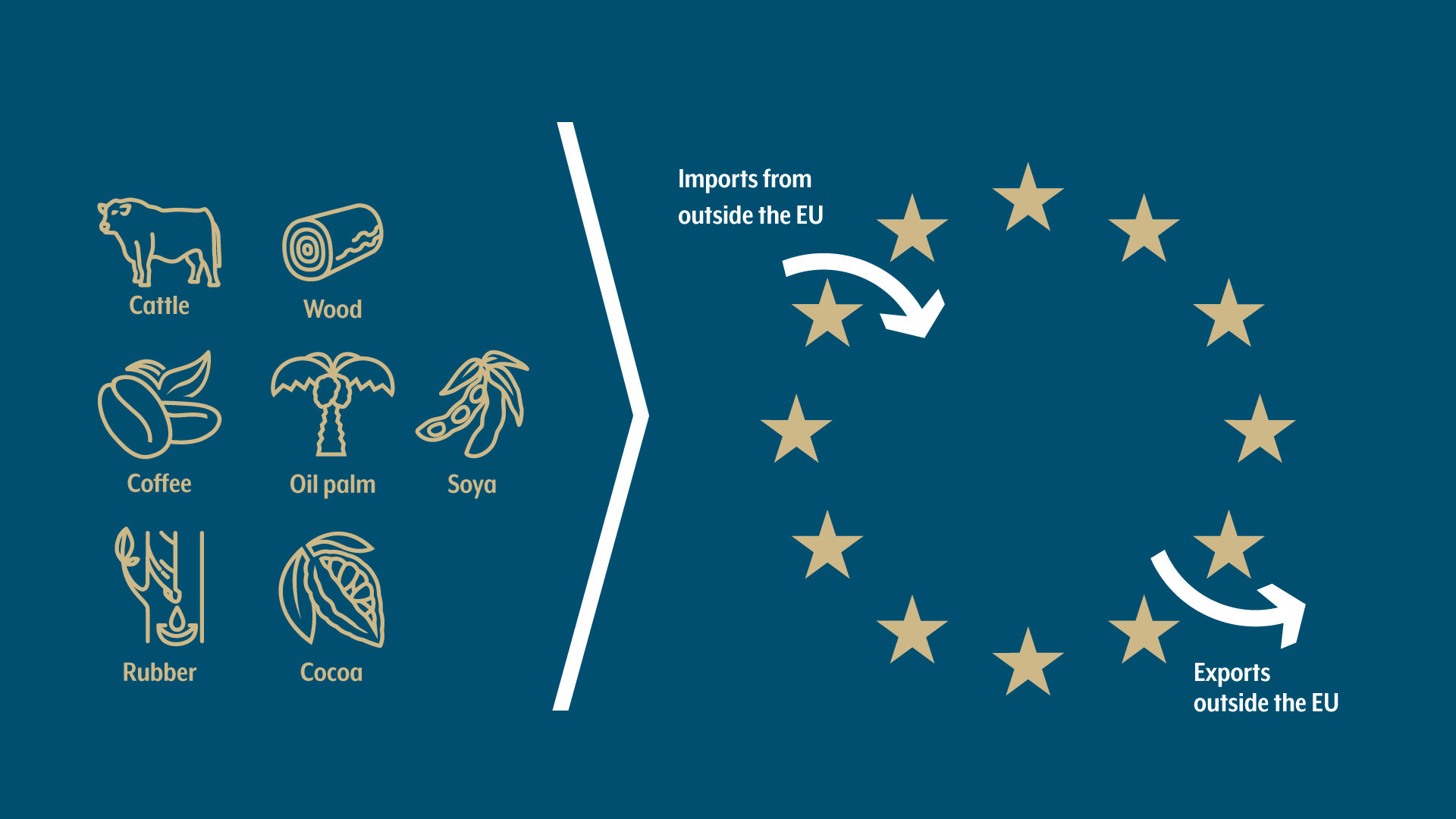
Under the EUDR, import means an import from outside the EU, and export refers to an export to a country outside the EU. An import company has the role of an operator within the meaning of the Regulation.
In the EUDR, an operator means a natural or legal person who, in the course of a commercial activity, places relevant products on the market or exports them, except for downstream operators.
The measures required under the EUDR should be carried out before making procurement decisions.
Measures in imports
1. Ensure that your due diligence system (DD system) is in place
Use your DD system to collect the required information, carry out a risk assessment and, where necessary, implement risk mitigation measures.
2. Submit a due diligence statement (DDS) in the EUDR Information System
Submit an electronic DDS in the EUDR Information System before importing the products. Indicate the DDS reference number in the customs declaration.
3. Provide the DDS reference number to the next actor in the supply chain
Provide the buyer of the products with the DDS reference number relating to the products if the customer remains subject to obligations under the EUDR.
4. Notify of possible non-compliance
Notify the competent authority and your customers that remain subject to obligations under the EUDR of any cases that come to your attention that include indications of possible non-compliance.
5. Reporting obligation for large undertakings
Large undertakings that are operators within the meaning of the Regulation are required to publish annual public reports on their due diligence system (DD system) (see Large Undertakings & EUDR).
Please note: Customs clearance cannot take place until the DDS has been submitted.
Measures in exports
- Downstream operators are not required to indicate the DDS reference number or the declaration identifier in the export declaration. The appropriate customs condition code must be used in the export declaration.
- If you are an operator, indicate the DDS reference number related to the products in the export declaration, or, in the case of a micro or small primary operator, the declaration identifier. A new DDS does not need to be submitted for the products.
Measures in re-imports
An importer who re-imports into the EU a product that has already been placed on the EU market is considered a downstream operator rather than an operator. In such cases, the importer's obligations are less extensive, as due diligence has already been carried out for the product. The importer must ensure, and demonstrate to the competent authority upon request, that the imported product has previously been placed on the EU market. Supporting documentation may include, for example, a customs declaration, contract or invoice. [ruokavirasto.fi], [ruokavirasto.fi]
In the case of re-imports, the reference number of the due diligence statement (DDS) originally submitted for the product, or the identifier of the simplified declaration, must be indicated in the customs declaration, if known. Otherwise, the universal DDS reference number communicated by the European Commission must be used in the customs declaration.
When re-importing a product that was originally placed on the EU market during the transitional period, the ‘universal reference number’ communicated by the Commission must be indicated in the customs declaration. For more information, see the Commission’s FAQ Version 5, Questions 9.1 and 9.2.