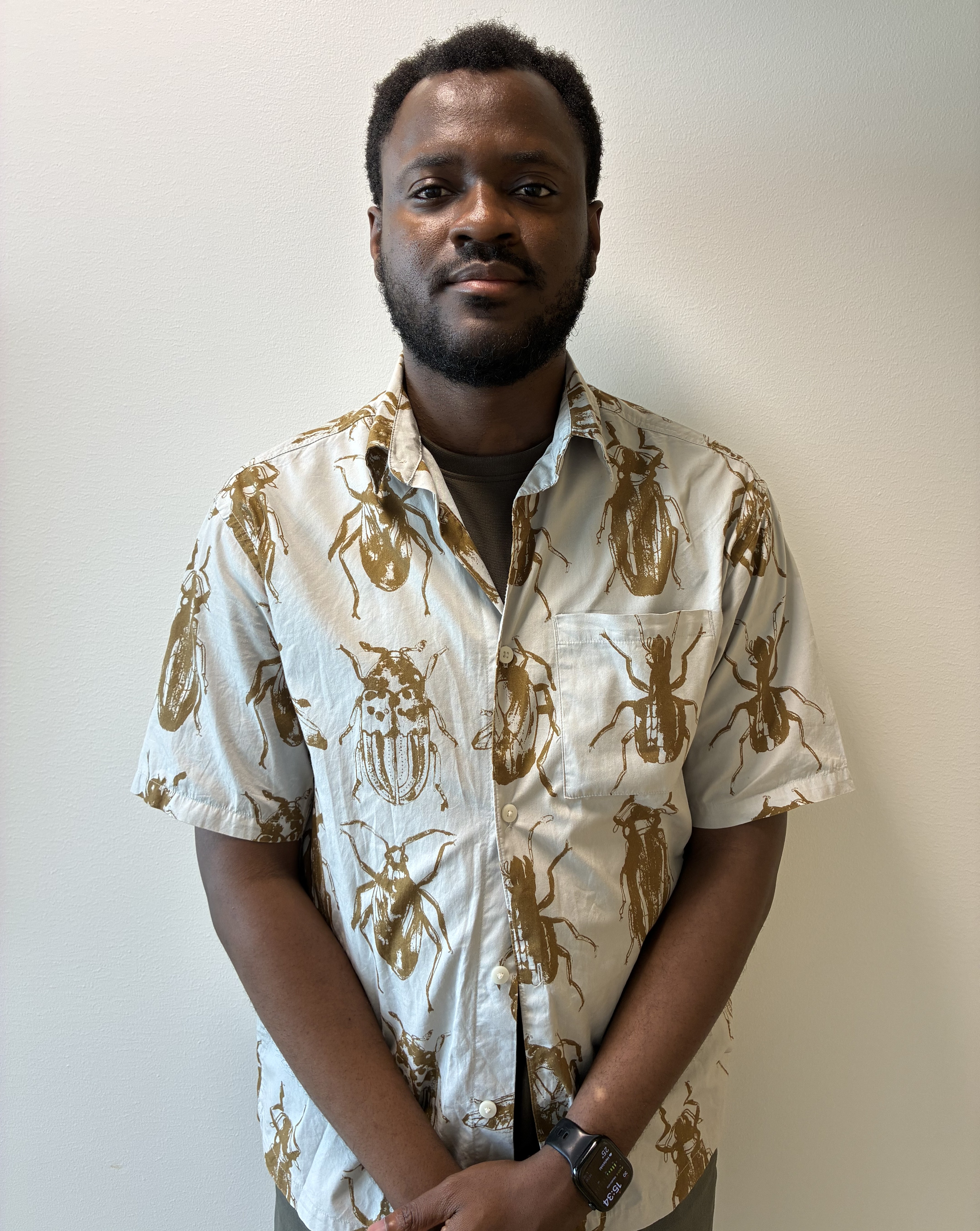
Leonard Owuraku Opare has started as a postdoctoral researcher at the Finnish Food Authority as part of the joint programme of the state research institutes, which aims to strengthen research and development expertise in key areas of society.
His research tackles a question that climate change is making increasingly urgent: as the organisms that spread animal diseases and damage crops shift their ranges, which of them could gain a foothold in Finland, and when?
– The insects that carry animal diseases and plant pathogens, and the pests that harm plants directly, are pushing steadily northward as temperatures rise. Threats that once felt remote are now arriving at our doorstep, Opare says.
The Finnish Food Authority brings nearly 25 years of risk-assessment work in plant health and animal disease to the problem, along with well-tested climatic suitability tools such as CLIMEX and MoPSi. Opare's project extends that foundation in two directions. For animal diseases, he is developing a capability to track how wind disperses Culicoides biting midges, embedding it in the Finnish Meteorological Institute's SILAM atmospheric transport model and using bluetongue virus as the proving ground. For plant pests, he turns the suitability tools to species flagged as regulatory risks using Bayesian statistical approaches.
– With the midge work, the aim is to connect dispersal to atmospheric transport, so an incursion of a virus like bluetongue can be seen coming sooner and across a broader front. With plant pests, suitability modelling tells us whether Finland's climate today and decades from now would let a newly arrived species take hold, he explains.
But a model is only as trustworthy as the evidence behind it, and that evidence is frequently thin and inconsistent. This is where the project leans on Bayesian statistics.
Welcome to hear more about Leonard Owuraku Opares’ project “Risk of Vector‑Transmitted Animal Diseases and Plant Pests in a Changing Climate” on Tuesday, 15 September 2026.
#tulanetpostdoc